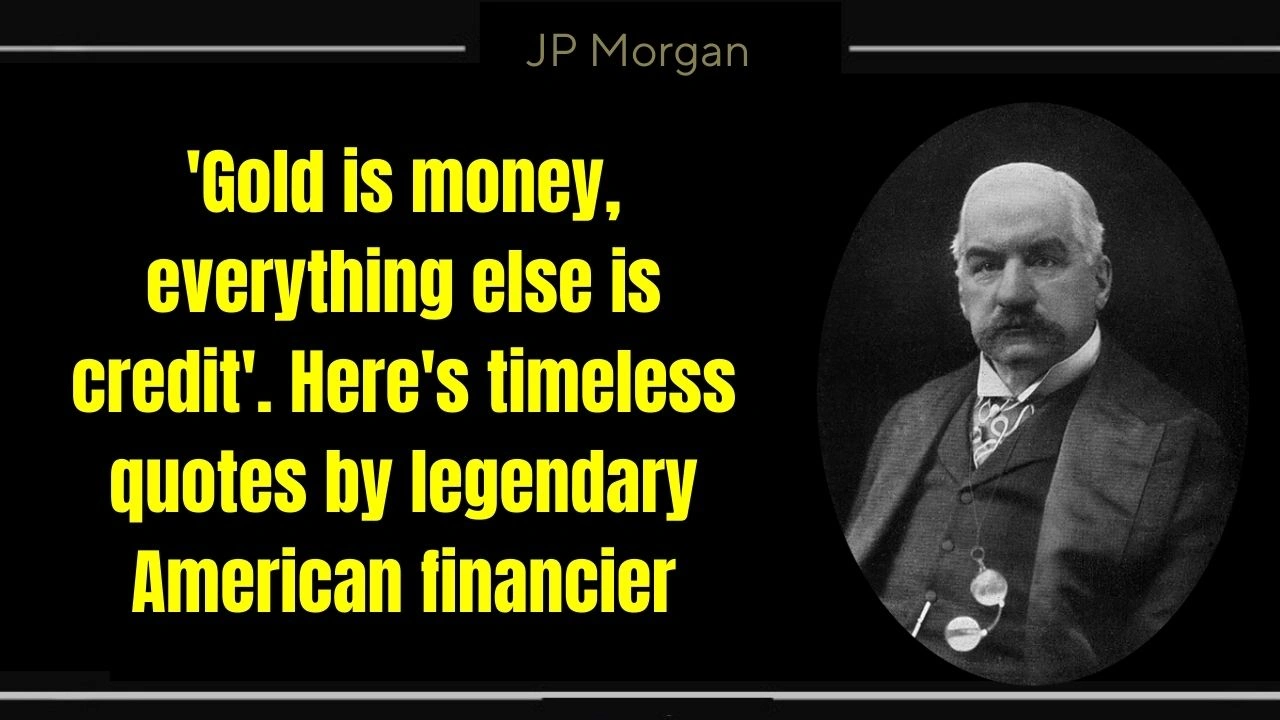
The quote of the day by JP Morgan is one of those rare lines that captures the heart of financial thinking in just a few words. It reads: “Gold is money. Everything else is credit.” At first glance, it might sound like a simple observation. But if you take a moment to reflect, it reveals a powerful truth about how our financial world operates. Gold, in its pure form, has always been seen as a store of real value, while other forms of currency rely on promises. This quote continues to resonate in modern economic discussions, especially as digital money and debt-driven systems dominate our financial lives.
What makes the quote of the day by JP Morgan so relevant today is how it bridges the past with the present. In an age of inflation, fiat currencies, credit bubbles, and rising debt, the quote invites us to consider what really holds value. This article will break down the deeper meaning behind the quote, explore J.P. Morgan’s legacy, and look at his most famous insights. You will also discover why his words are still quoted by financial experts, investors, and students around the world.
Quote of the day by JP Morgan and its importance
The quote of the day by JP Morgan is not just a catchy phrase; it is a reflection of financial wisdom rooted in reality. By saying “Gold is money. Everything else is credit,” Morgan drew a clear line between assets that have intrinsic value and those that depend on someone else’s promise. Gold does not need a signature, a guarantee, or a backing institution to be worth something. It is universally accepted and time-tested.
In contrast, credit works only when there is trust. Whether it is a dollar bill or a digital bank balance, it is essentially a form of IOU. The reason this quote is still widely quoted is because even in today’s high-tech financial systems, that basic idea holds true. If trust fails, the whole system can break down. That is why investors turn to gold in uncertain times—it is the fallback when everything else seems risky.

Overview Table: Key Glance at JP Morgan and His Quote
| Aspect | Details |
| Famous Quote | “Gold is money. Everything else is credit.” |
| Who Said It | J.P. Morgan |
| Year of Birth | April 17, 1837 |
| Date of Death | March 31, 1913 |
| Contribution | Shaped American banking and finance |
| Major Companies Supported | U.S. Steel, General Electric, International Harvester |
| Crisis Management | Rescued U.S. gold reserves in 1893, led recovery in 1907 panic |
| Known For | Building one of the most powerful banking empires |
| Legacy | Created lasting institutions, collector of art and books |
| Current Relevance | His quotes still guide financial thinking |
Who was J.P. Morgan?
J.P. Morgan was not just a businessman; he was a force in shaping the U.S. economy. Born in 1837 in Hartford, Connecticut, he came from a family already engaged in finance. He studied in Boston and later in Germany, which gave him a global view of money and markets. By the time he entered the financial world in New York, Morgan was already prepared to play on a larger stage.
His career took off when he joined Drexel, Morgan and Company. That firm would later evolve into J.P. Morgan and Company, a powerhouse in global finance. Morgan was known for his strong personality, clear vision, and the ability to act decisively during financial chaos. He was not afraid to use his resources to stabilize markets and help the country when it mattered most.
J.P. Morgan early life and education
Growing up under the influence of his father, Junius Spencer Morgan, J.P. Morgan was introduced early to the workings of international finance. He received formal education in the United States before continuing his studies in Europe at the University of Göttingen. This gave him a unique edge—a combination of American drive and European discipline.
In 1857, he started his career as an accountant in New York. His attention to detail and sharp mind quickly set him apart. Soon, he was handling bigger deals and became the face of his father’s banking operations in the United States. His early years laid the foundation for what would become one of the most influential careers in American financial history.

JP Morgan banking empire rise
By the 1870s, Morgan had already made a name for himself. In 1871, he became a key partner in Drexel, Morgan and Company. When the firm transitioned to J.P. Morgan and Company in 1895, it became a major player in both national and international finance. His firm financed the U.S. government and acted as a channel for massive capital flows.
What made his empire unique was the way it combined banking with real industry. He was not just lending money—he was shaping the companies he invested in. Morgan’s bank backed large-scale mergers and helped America move from a rural economy into an industrial one.
Role in railroads and industry
Morgan’s influence over railroads transformed American infrastructure. In the late 1800s, the railroad industry was in chaos. Competition was fierce, and many companies were going bankrupt. Morgan stepped in and reorganized the system, making it more efficient and financially stable.
Beyond railroads, Morgan played a leading role in forming General Electric, United States Steel, and International Harvester. These were not just companies—they were pillars of American industrial growth. United States Steel became the first company in the world valued at over a billion dollars, a milestone that changed the landscape of business forever.

Financial crises and global influence
During times of financial panic, Morgan proved why he was trusted by Wall Street and Washington. In 1893, when the U.S. gold reserves ran dangerously low, Morgan arranged a deal to lend the government $62 million in gold. This act restored public confidence and helped stabilize the economy.
Again in 1907, the country faced another financial crisis. There was no central bank at the time. Morgan gathered top bankers in his library, reviewed balance sheets, and coordinated support for failing institutions. His efforts prevented a complete collapse of the financial system. His role during these events showed that his influence was global and deeply rooted in trust.
Legacy beyond finance
J.P. Morgan was not just a financier—he was also a lover of culture and knowledge. He collected art, rare manuscripts, and historical books. Many of his collections were donated to institutions like the Metropolitan Museum of Art. His personal library became the Morgan Library and Museum, a landmark in New York City.
His influence extended beyond his lifetime. Many of the institutions he helped shape are still around today, including what is now JPMorgan Chase, one of the world’s largest banks. His quotes, especially the quote of the day by JP Morgan, continue to inspire those who study economics and finance.
Timeless quotes by legendary American financier JP Morgan
- “The first step towards getting somewhere is to decide that you are not going to stay where you are.”
- “A man always has two reasons for what he does—a good one, and the real one.”
- “Go as far as you can see; when you get there, you will be able to see farther.”
- “If you have to ask how much it costs, you cannot afford it.”
- “Millionaires do not use astrology, billionaires do.”
Each of these quotes, including the quote of the day by JP Morgan, offers a lesson in leadership, money, and decision-making that feels just as relevant today as it did over a century ago.
FAQs
Q1: What does the quote of the day by JP Morgan mean?
It means gold has real value that does not rely on trust, while credit is only valuable if people believe in it.
Q2: Why does the quote of the day by JP Morgan matter in 2026?
Because it helps people understand the difference between real assets and debt-based systems, which is key in today’s financial world.
Q3: How did J.P. Morgan help during financial crises?
He used his banking resources and leadership to rescue the U.S. gold reserve in 1893 and prevent collapse during the 1907 panic.

Q4: What companies did J.P. Morgan support or create?
He helped form U.S. Steel, General Electric, and International Harvester—giants in American industry.
Q5: Is gold still considered money today?
Yes, many investors still view gold as a safe asset, especially during times of economic uncertainty, just as the quote of the day by JP Morgan suggests.