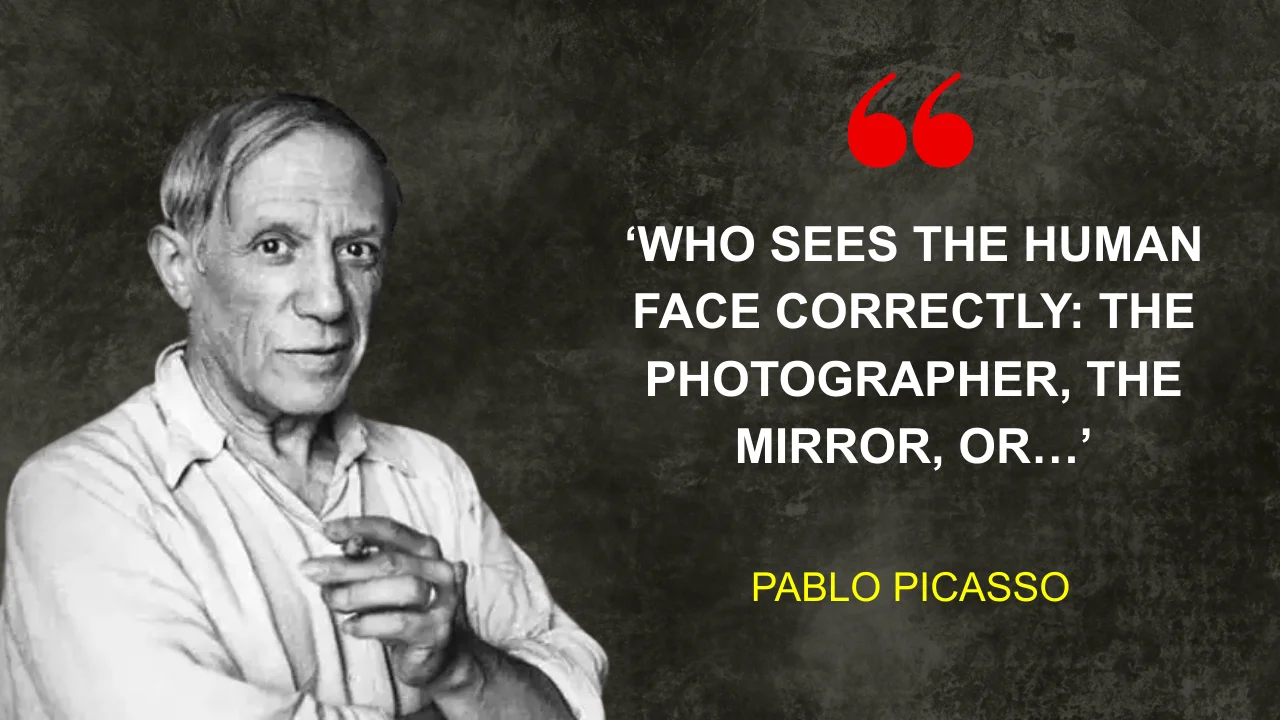
Thought of the Day by Pablo Picasso: Thought of the Day by Pablo Picasso continues to spark curiosity among art lovers, students, and deep thinkers around the world. The question he raised about who truly sees the human face correctly feels simple at first, but the more you think about it, the more powerful it becomes. In classrooms, art studios, and even across social media feeds in 2026, the Thought of the Day by Pablo Picasso is widely shared because it touches something personal in all of us.
In this blog, we will break down the deeper meaning behind this quote, explore the life and artistic journey of Pablo Picasso, and understand why this reflection still matters in a world shaped by selfies, digital filters, and artificial intelligence generated images. If you are searching for the real meaning of this quote or its relevance today, this guide gives you clear and practical insight.
Thought of the Day by Pablo Picasso
The Thought of the Day by Pablo Picasso is more than a clever line about art. It is a serious question about truth, perception, and identity. When Picasso asked, “Who sees the human face correctly: the photographer, the mirror, or the painter?” he challenged the belief that reality can be captured in a single, perfect way. A mirror reflects detail but reverses the image. A photograph captures a frozen second shaped by lighting and angle. A painter interprets emotion, memory, and imagination. Each one shows something real, yet incomplete.
In 2026, when millions of photos are uploaded daily and face editing tools are more advanced than ever, this question feels even more relevant. The Thought of the Day by Pablo Picasso pushes us to rethink how we define authenticity. It reminds readers that perception is layered and truth depends on perspective. That idea forms the core of his artistic philosophy and explains why his work transformed modern art.
Overview Table
| Key Aspect | Details |
| Focus Quote | “Who sees the human face correctly: the photographer, the mirror, or the painter?” |
| Artist | Pablo Picasso |
| Birth | October 25, 1881, Málaga, Spain |
| Death | 1973, Mougins, France |
| Art Movement | Cubism |
| Co Founder of Cubism | Georges Braque |
| Famous Artwork | Les Demoiselles d’Avignon |
| Political Masterpiece | Guernica |
| Core Theme of Quote | Truth and perception |
| Modern Relevance | Digital identity, selfies, image culture 2026 |
Thought of the day today
The quote shared as a daily reflection invites us to pause before accepting any image as complete truth. Today, people carefully control how they appear online. Social media platforms are filled with edited portraits, perfect lighting, and curated angles. According to recent 2026 digital culture studies, over 70 percent of users admit to editing their photos before posting them.

This is why the Thought of the Day by Pablo Picasso connects strongly with modern readers. It reminds us that a photograph might look real, but it is still shaped by choices. Even a mirror only shows what stands in front of it at one moment. Picasso encourages us to question surface appearances and look deeper.
Thought of the day meaning
The true meaning behind the Thought of the Day by Pablo Picasso lies in understanding perception. A mirror reflects faithfully but cannot show emotions hidden behind a smile. A camera captures detail but misses the story behind the eyes. A painter may distort features yet reveal inner struggle or joy.
Picasso believed that art should not simply copy reality. He saw painting as a way to explore psychological truth. His question suggests that no one sees perfectly. Every method of seeing carries its own limits. This idea expands beyond art into daily life. When we judge others based on appearance alone, we may only be seeing one version of their truth.
Thought of the day by Pablo Picasso
Pablo Picasso was born in Spain in 1881 and showed artistic talent from an early age. His father was a drawing teacher who introduced him to classical techniques. As a teenager, Picasso studied in Barcelona and later moved to Paris, where modern art was evolving rapidly.
Throughout his long career, he refused to stay in one style. He constantly experimented, questioned tradition, and redefined artistic rules. The Thought of the Day by Pablo Picasso reflects this restless mindset. He never accepted that one viewpoint was enough. His art explored multiple angles, both visually and emotionally.

Blue Period to Rose Period: Searching for vision
In the early 1900s, Picasso entered what is now known as the Blue Period. His paintings were filled with cool blue tones and figures that looked sad or isolated. These faces were not painted to look perfect. They expressed emotion and hardship.
Later, during the Rose Period, warmer colors replaced blue shades. Circus performers and softer human expressions became central themes. This shift showed how his perception of life evolved over time. The Thought of the Day by Pablo Picasso fits perfectly here because his art proves that vision changes with mood, experience, and growth.
A face painted in blue may not match a photograph, but it can express loneliness more deeply than any camera.
Guernica and the politics of perception
One of Picasso’s most powerful works is Guernica, created in response to the bombing of a Spanish town during war. Instead of painting a realistic battlefield scene, he used fragmented shapes and dramatic expressions to show pain and chaos.
The distorted faces in Guernica do not look traditionally accurate. Yet they communicate fear and suffering with intense clarity. The Thought of the Day by Pablo Picasso becomes especially meaningful here. A photograph documents destruction. A painting like Guernica communicates emotional shock and collective trauma.

This shows that artistic interpretation can reveal truths that mechanical tools cannot capture.
Cubism and beyond
Picasso, along with Georges Braque, developed Cubism. This movement broke objects and faces into geometric shapes and displayed multiple angles at once. Instead of painting a face from one side, Cubism showed it from many viewpoints simultaneously.
This directly connects to the Thought of the Day by Pablo Picasso. If a face can be seen from different perspectives at the same time, then no single mirror or photograph can claim complete accuracy. Cubism suggests that reality is complex and layered.
Later in his career, Picasso experimented with collage and sculpture. He mixed materials and blurred the line between imagination and reality. His work consistently questioned how we see and understand the world.
Legacy of a restless eye
Picasso died in 1973, but his influence remains strong in 2026. Museums around the world still attract millions of visitors eager to study his work. Art students continue to analyze his bold style. His question about perception remains widely discussed in philosophy, psychology, and media studies.

The Thought of the Day by Pablo Picasso survives because it applies to more than art. It speaks to identity, self image, and the search for truth. In a digital age where artificial intelligence can generate realistic faces in seconds, the idea of who sees correctly becomes even more complex.
His legacy teaches us that seeing is not passive. It is active, thoughtful, and deeply personal.
FAQs
1. What is the main message of the Thought of the Day by Pablo Picasso?
It highlights that no single method of seeing can capture complete truth. Every perspective shows only part of reality.
2. Why is this quote still relevant in 2026?
Because modern life is filled with edited images and digital identities, making questions about authenticity more important than ever.
3. How does Cubism relate to this quote?
Cubism presents multiple viewpoints at once, showing that reality is layered and cannot be reduced to one angle.

4. Did Picasso believe painting was superior to photography?
He did not claim superiority. He suggested that each method reveals different aspects of truth.
5. How can this quote apply to daily life?
It reminds people not to judge based only on appearances and to understand that every person has multiple layers.