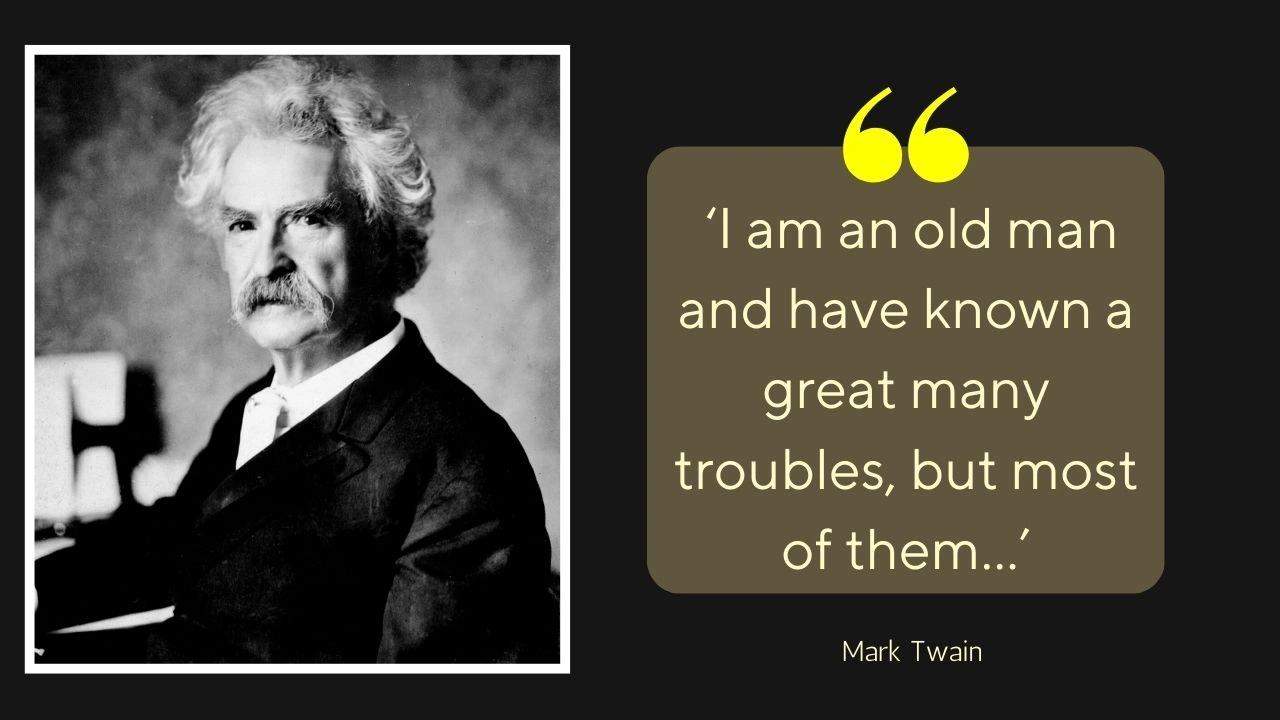
Quote of the Day by Mark Twain has been making waves online, especially this timeless gem: “I am an old man and have known a great many troubles, but most of them never happened.” It hits you with a mix of humor and reality that only someone like Mark Twain could deliver. It is one of those quotes that sticks with you, not just because it is clever, but because it says something true about life.
This quote of the day by Mark Twain goes far beyond a witty remark. It speaks to how we humans often stress over things that may never happen. In this article, we are going to explore not only the story behind this quote but also how it ties into Mark Twain’s fascinating life. From his early days in Missouri to his experiences with riverboats, writing, and even Halley’s Comet, Twain lived a life full of lessons that still apply today.
Quote of the Day by Mark Twain
Let us talk about what makes this quote so powerful. When Twain said, “I am an old man and have known a great many troubles, but most of them never happened,” he tapped into a truth about anxiety that many people overlook. Most of the time, we get stuck in our heads imagining worst-case scenarios. Twain’s words are a simple but sharp reminder that much of our stress is self-created.
This quote of the day by Mark Twain does not just deliver humor. It delivers perspective. It invites you to look at your worries and ask, “Is this real, or am I just assuming the worst?” That is why this quote continues to trend on social media and quote sites. It is relatable, evergreen, and exactly what people need to hear in today’s stress-filled world. Twain may not have known the modern term “overthinking,” but he certainly understood the damage it can cause.

Overview Table: A Glance at Mark Twain and the Famous Quote
| Topic | Details |
| Famous Quote | “I am an old man and have known a great many troubles, but most of them never happened.” |
| Real Name | Samuel Langhorne Clemens |
| Pen Name Origin | “Mark Twain” was a riverboat term meaning 12 feet of water depth |
| Birth Year | 1835, shortly after Halley’s Comet appeared |
| Death Year | 1910, right after the comet returned |
| Hometown | Hannibal, Missouri |
| Military Service | Briefly joined a Missouri militia during the Civil War |
| Writing Career Start | Rose to fame in 1865 with The Celebrated Jumping Frog of Calaveras County |
| Religion | Raised Presbyterian, though often critical of organized religion |
| Life Legacy | Renowned for humor, deep insights, and storytelling rooted in American life |
Mark Twain’s “Troubles” Quote Says More About Anxiety Than Humor
At first glance, Twain’s quote sounds like a joke from an old man reflecting on life. But if you dig deeper, it is actually a commentary on the human mind. We are wired to worry, to think about what might go wrong. Twain knew this and put it into a sentence that feels both light and heavy. This quote connects to our daily struggles with stress and fear.
In today’s fast-moving world, where headlines and alerts constantly fuel anxiety, this quote feels more relevant than ever. It is not just clever wordplay. It is life advice. The kind that makes you stop scrolling, take a breath, and think, “Maybe I am worrying too much.” And that is why this quote continues to stand out across generations.
Cometary Coincidence: Twain and Halley’s Comet
One of the most fascinating things about Twain’s life is how it started and ended with Halley’s Comet. Born in 1835, just two weeks after the comet passed Earth, Twain joked that he would leave with it too. In 1909, he said, “It is coming again and I expect to go out with it.” Sure enough, he passed away in April 1910, just as the comet made its next close approach.
This strange coincidence added a cosmic touch to Twain’s already legendary life. It is the kind of thing that makes you believe in poetic timing. Twain was not just a master of words. His life seemed to follow a script that was just as curious and thought-provoking as his writing.

Raised Presbyterian, Yet Spiritually Complex
Twain was raised in a strict Presbyterian household, but he later became highly critical of religion and its institutions. His views grew more skeptical as he aged, especially after experiencing personal losses and societal injustice. Still, he held onto certain spiritual ideas and often referenced “The Almighty” in his own satirical way.
Interestingly, his funeral was held in a Presbyterian church, a reflection of the tradition he was raised in, even if he had grown apart from it. This balance between belief and criticism shows Twain’s ability to hold opposing ideas, a trait that helped him write about human complexity so well.
“Rollin’ on a River”: Riverboats and Inspiration
Growing up in Hannibal, Missouri, meant the Mississippi River was more than just scenery for Twain. It was a central part of his childhood and later, his career. At the age of 21, he trained to become a steamboat pilot. That world gave him his pen name, “Mark Twain,” a term used by riverboat crews to mark safe water depth.
The river shaped Twain’s imagination and inspired books like Adventures of Huckleberry Finn. He saw life as something that flowed like a river, full of twists and turns, danger and calm. His river experiences gave him stories and metaphors that filled his work with life and movement.

A Short-Lived Military Career Turned Into Satire
In 1861, Twain joined a group of local volunteers in Missouri to defend the state during the Civil War. He only stayed for two weeks. Twain later turned that brief stint into a humorous short story called The Private History of a Campaign That Failed, poking fun at war and idealistic patriotism.
What stands out is how Twain took what could have been an embarrassment and turned it into a literary success. He had the rare gift of seeing the funny side of failure and using it to connect with readers. This shows his strength not just as a writer, but as an observer of human nature.
A Writing Career Sparked Out West
After leaving the militia, Twain moved west with his brother Orion and started working as a journalist. It was there that his writing career truly began. His first big hit, The Celebrated Jumping Frog of Calaveras County, was published in 1865 and marked the beginning of his rise to fame.
That success opened the door to novels that would become American classics. Twain had a way of capturing real people, real language, and real feelings in a way few writers could. His work continues to be read not just because it is funny, but because it is honest.

Two Key Takeaways from Mark Twain’s Life and Work
- His Quotes Carry Deep Meaning
Twain’s quotes are not just clever lines. They are reflections on life, worry, belief, and human nature. - His Life Was Full of Inspiration
From the Mississippi River to the Wild West, Twain’s journey gave him stories that shaped his voice and gave the world timeless literature.
FAQs
Did Mark Twain actually say the “old man and troubles” quote?
The quote is widely attributed to him, though scholars debate its origin. However, it reflects his tone and themes perfectly.
What does the quote really mean?
It shows how people tend to worry about things that never even happen, highlighting how we create our own stress.
Why is Mark Twain still so popular today?
Because his writing is honest, relatable, and filled with wit. His observations about life still apply today.
What inspired Twain’s pen name?
The name “Mark Twain” comes from a riverboat term meaning 12 feet of safe water. It ties directly to his time as a steamboat pilot.

How did Twain begin his writing career?
He started writing in Nevada while working as a journalist. His first major success came in 1865 with a humorous short story.